
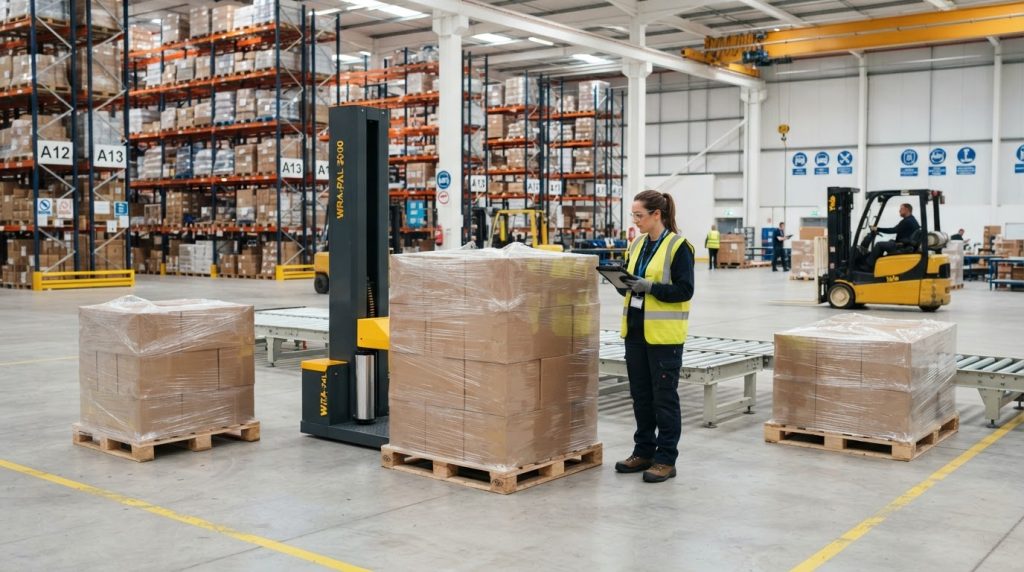
A manufacturing customer handling palletized goods needed a more reliable way to prepare finished products for warehouse storage and transportation. The customer had been using manual wrapping for many pallets each day, but the results depended heavily on operator experience. Some loads were wrapped too loosely, while others used excessive film.
The customer wanted a solution that could improve pallet stability, reduce packaging variation, and make the end-of-line process easier for operators. After reviewing the product dimensions, pallet weight, daily output, and site layout, a stretch wrapping machine was recommended for the application.
Customer challenge
The main issue was inconsistent wrapping quality. When pallets were wrapped manually, film tension was difficult to control. Operators had to walk around each pallet several times, which increased labor intensity and slowed down the packaging process during busy production periods.
- Unstable pallet loads during handling and transport
- High dependence on manual wrapping skill
- Uneven film usage and unnecessary waste
- Packaging speed unable to keep up with production peaks
- Need for a simple machine that operators could learn quickly
Recommended solution
A stretch wrapping machine with adjustable wrapping programs was selected. The machine allowed the customer to set suitable wrapping layers, turntable speed, film tension, and top-bottom reinforcement according to the pallet load. The goal was not only to speed up wrapping, but also to make every pallet more consistent.
The solution was designed for practical daily operation. Operators could place the pallet on the machine, attach the film, choose the correct program, and start the wrapping cycle. This reduced repetitive manual movement and helped standardize the packaging process.
Implementation results
After installation, the customer reported a smoother end-of-line workflow. Pallets were wrapped with more consistent tension and better visual quality. The improved load stability made it easier to move pallets by forklift and prepare them for shipment.
Operators also adapted quickly because the machine interface was straightforward and the wrapping cycle was repeatable. Instead of spending time manually walking around each pallet, they could manage loading, unloading, and inspection more efficiently.
Value delivered
- More stable pallets for warehouse handling and transportation
- Reduced manual effort in the wrapping process
- More consistent film application and packaging appearance
- Improved end-of-line efficiency during peak production
- A flexible solution suitable for different palletized products
This case shows how the right stretch wrapping solution can create immediate improvements in packaging reliability. For companies that ship palletized goods, standardized wrapping is a practical investment in product protection, operational efficiency, and customer satisfaction.